
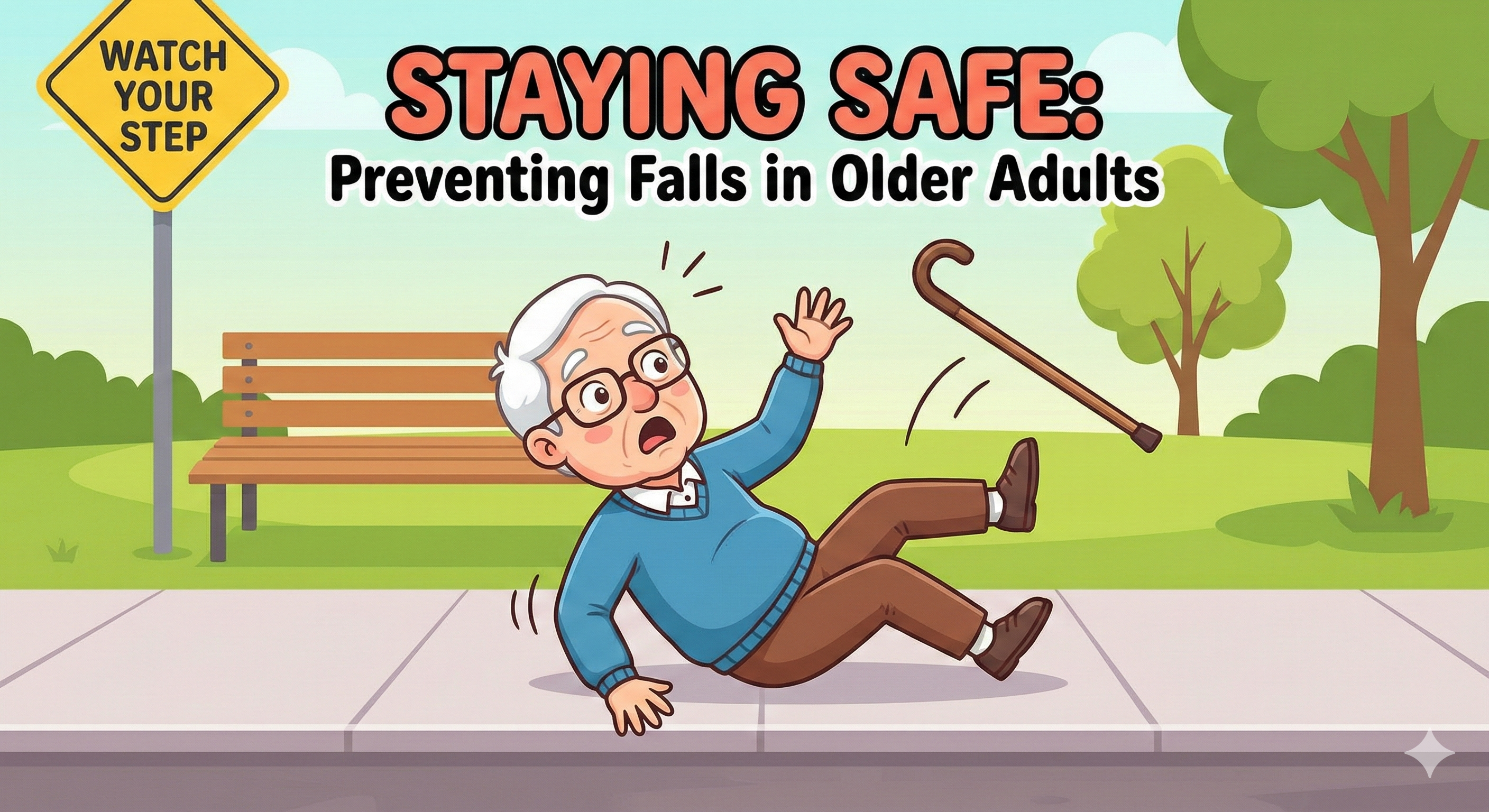
Falls in the Elderly: A Preventable "Silent Killer"
Risk Assessment & Home Safety Guide
Did you know that "Falling" is the second leading cause of accidental death, right behind road traffic accidents? In Thailand alone, over 2,000 people die from falls every year, and nearly half of them are elderly.
Today, we are summarizing the guidelines for risk assessment and proper environmental modification from the Department of Disease Control.
Who is at Risk?
The risk of falling increases with age, but there is an interesting distinction between genders:
Men: Have a death rate from falls that is 3 times higher than women. Most falls for men occur outside the home or while traveling.
Women: Fall 1.5 times more frequently than men, but more than half of these incidents occur inside the house or within the home perimeter.
Self-Check: Are You at Risk? (Thai-FRAT)
You can assess your own risk using the Thai Fall Risk Assessment Test (Thai-FRAT). If your total score is 4–11 points, you are considered "at risk" and should seek advice from a healthcare professional.
The 6 Risk Factors:
Gender: Female (1 point), Male (0 points).
Vision: Cannot read standard letters at a distance of 6/12 meters (1 point).
Balance: Cannot stand in a "Tandem Stance" (heel-to-toe) for 10 seconds (2 points).
Medication: Taking 4 or more medications, or taking sleeping pills, antidepressants, antihypertensives, or diuretics (1 point).
Fall History: Have fallen 2 or more times in the past 6 months (5 points).
Home Environment: Living in a raised-floor house (1.5m+) that requires using stairs (1 point).
Simple Exercises to Improve Balance
Exercising at home can significantly reduce fall risk. Try these simple movements:
Tandem Stance: Stand with one foot directly in front of the other (heel touching toe). Hold a rail for safety. Hold for 10 seconds, then switch feet.
Tandem Walk: Walk in a straight line, placing your heel directly in front of the toes of your other foot with each step. Use a handrail for support. Walk 10 steps forward and return.
Leg Strengthening:
Calf Raises: Stand on tiptoes, then rock back onto your heels.
Knee Bends: Standing partial squats.
Knee Extensions: Sit on a chair and straighten your leg out.
Do these 10 times per side.
How to Fall-Proof Your Home
A safe environment can prevent a massive number of accidents. Here are the recommended modifications:
Living Area: Elders should live on the ground floor or in a single-story house to avoid stairs.
Bedroom: The bed height should be level with the back of the knee (approx. 40–45 cm) to make standing up and sitting down easy.
Stairs:
Risers (vertical part) should not exceed 15 cm.
Treads (step width) should be at least 28 cm.
Install handrails on both sides at a height of 80 cm.
Bathroom:
Use a sit-down toilet (height 40–45 cm).
Install grab bars.
Ensure the floor is non-slip.
Do not lock the door while using the bathroom (in case of emergency).
Lighting: Light switches should be installed 120 cm from the floor so they are easy to reach without stretching.
Source: https://www.rama.mahidol.ac.th/fammed/th/article/patient/14aug2020-1312
